How to choose an AI tool without wasting money starts with a clear job, not a list of fashionable features. This guide gives you a repeatable 12-point framework for comparing AI software, testing it with real work and deciding whether the result is valuable enough to adopt.
Learning how to choose an AI tool is useful for writing assistants, coding agents, meeting tools, research platforms, image generators, automation products and business software with AI features. You can use the interactive scorecard above, then apply the checks below before starting a paid subscription.
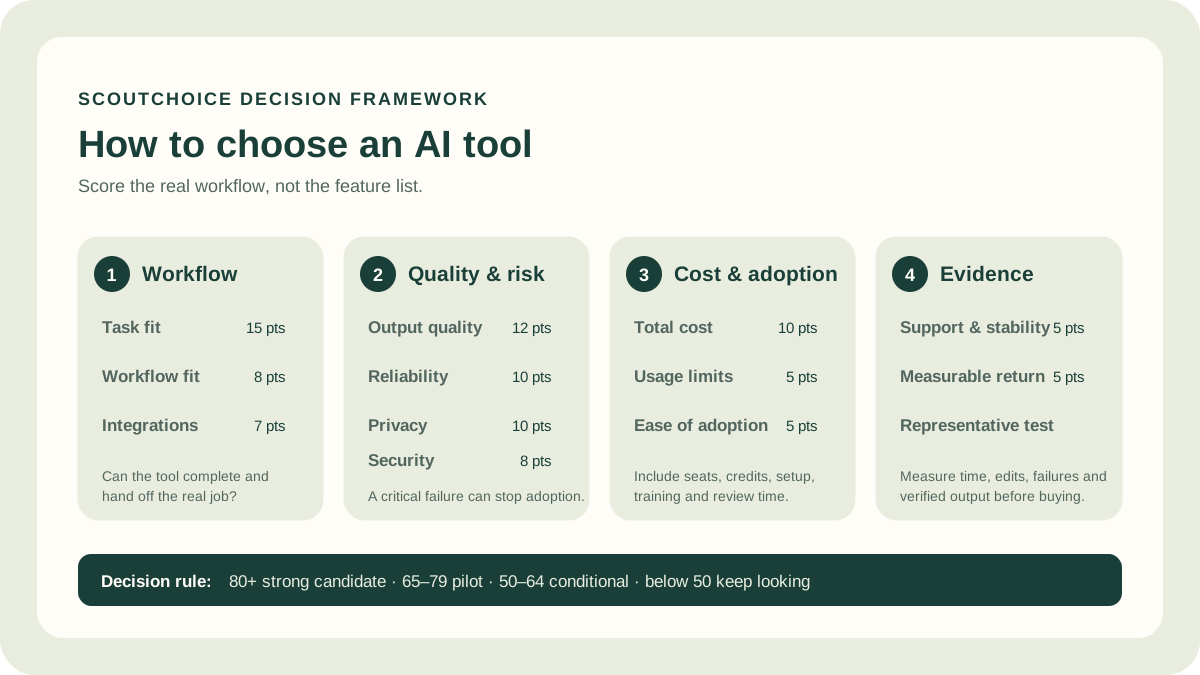
1. Start with the job, not the product
Write down the recurring task you want to improve in one sentence. A useful statement is specific: “turn a 45-minute customer call into reviewed notes and CRM tasks within ten minutes.” “Use AI for meetings” is too broad to evaluate.
Record the current process, who performs it, how long it takes, what a good result looks like and what errors would be unacceptable. This becomes your baseline. If the product cannot improve that workflow, extra features do not make it a good purchase.
2. How to choose an AI tool with 12 weighted criteria
The ScoutChoice framework uses twelve criteria and a total of 100 weighted points. A product does not need a perfect score. It needs to be strong in the areas that matter for your particular workflow and safe enough for the information involved.
Task fit — 15 points
Can the tool complete the exact job you defined, including the important inputs, output format and handoff? Test the whole workflow rather than one impressive prompt.
Output quality — 12 points
Judge accuracy, usefulness, structure and the amount of editing required. Build a small test set that includes easy, normal and difficult examples. A polished demonstration is not evidence that your own material will produce the same result.
Reliability and control — 10 points
Repeat the same type of task several times. Check whether the tool follows instructions, handles edge cases, shows sources where appropriate and lets a person review or reverse consequential actions.
Data privacy — 10 points
Identify what you would upload: public text, customer records, source code, contracts, employee information or meeting audio. Check retention, model-training choices, deletion, data location and the controls available on the plan you would actually buy.
Security and administration — 8 points
For team use, review authentication, permissions, workspace separation, audit information and offboarding. A useful product can still be unsuitable if access cannot be limited to the right people.
Workflow fit — 8 points
Measure the steps required to move from your existing input to an approved result. Switching between several applications, copying data manually or rebuilding context can remove much of the promised time saving.
Integrations and export — 7 points
Check whether the product connects to the systems you already use and whether your data can be exported in a usable format. Portability matters if prices change, the product closes or your team later chooses another provider.
Total cost — 10 points
Do not compare only the advertised monthly price. Include seats, annual commitments, credits, model surcharges, storage, API use, implementation time, training and the cost of reviewing AI output.
Usage limits — 5 points
Translate credits, minutes, generations or tokens into your real workload. Estimate a normal month and a busy month. A low starting price may be poor value if the useful model or volume requires frequent upgrades.
Ease of adoption — 5 points
Count setup time, training and the number of people who must change their habits. Test with the least technical intended user, not only the person who selected the software.
Support and provider stability — 5 points
Review documentation, support channels, product-change history and how dependent the workflow would become on the provider. This is not a prediction that a company will succeed; it is a measure of the disruption you would face if the service changed.
Measurable return — 5 points
Define the result before purchase: hours saved, faster response, lower editing time, more completed work or fewer manual steps. Benefits that cannot be observed are difficult to distinguish from novelty.
3. Run a representative test
Use the same five to ten tasks for every shortlisted product. Remove confidential information unless you have approved the data terms and controls. Record the starting material, time required, failed attempts, final output, edits and any additional cost.
A fair test should include at least one difficult example. If you are testing a research assistant, include an ambiguous question and verify every citation. For a meeting assistant, test speaker names, decisions and action items. For an AI coding tool, use a small repository change with tests and review the diff rather than judging whether the explanation sounds confident.
4. Calculate the real monthly cost
Use this simple formula: subscription cost + expected usage charges + implementation and review time. Convert annual prices to a monthly equivalent, but record that the cash commitment is annual. For teams, calculate the number of paid seats you actually need and whether occasional users can work without a full licence.
Then divide the total monthly cost by the number of successful outputs or verified hours saved. This produces a more useful comparison than “$20 per month” because it connects price with an outcome.
5. Match safeguards to the data
A recipe prompt and a customer database do not carry the same consequences. Classify the information before selecting the tool: public, internal, confidential, personal or regulated. Higher-impact use requires stronger evidence, clearer permissions and more human oversight.
The voluntary NIST AI Risk Management Framework highlights characteristics such as validity, reliability, safety, security, transparency, explainability, privacy and fairness. A small buying decision does not require implementing the entire framework, but these characteristics are a useful reminder that capability alone is not trustworthiness.
6. Decide whether free or paid is enough
Use a free plan to test basic fit, but compare it with the paid tier you would operate. Providers may reserve better models, larger context, integrations, exports, privacy controls or administration for paid plans. A free version is valuable only if its limits allow a representative test.
Upgrade when a specific paid capability removes a proven bottleneck or when the required privacy and team controls are unavailable for free. Do not upgrade simply because the free allowance has been used during unstructured experimentation.
7. Watch for common warning signs
- The demonstration uses ideal inputs but your normal data is messy.
- The output looks polished but contains facts you cannot verify.
- Important limits are described as credits without a realistic workload example.
- Export, deletion or model-training choices are unclear.
- The workflow requires more manual copying than the existing process.
- The tool duplicates features already included in another subscription.
- The annual discount is presented more prominently than the commitment or overage cost.
- No one is assigned to review output, permissions and continued value after adoption.
8. Use clear decision rules
A score of 80 or more indicates a strong candidate for the tested workflow, not a universal recommendation. A score between 65 and 79 usually justifies a limited pilot. Between 50 and 64, proceed only if the tool solves one unusually valuable problem. Below 50, keep looking or improve the definition of the task.
When deciding how to choose an AI tool, apply an additional stop rule: do not adopt a product with an unacceptable privacy, security or reliability weakness merely because its total score is high. Weighted averages should support judgment, not hide a critical failure.
9. Build a shortlist with ScoutChoice
Start in AI Tool Categories when you know the type of product you need, or use the AI Tool Finder when you want recommendations based on workflow and access requirements. Open the relevant Best AI Tools rankings to understand the strongest candidates, then use side-by-side comparisons to examine the final two options.
Your scorecard should reflect your own data, risks and workflow. A lower-ranked product can be the better choice when it performs the critical task more reliably or fits your existing stack at a lower total cost.
Frequently asked questions
What is the most important factor when choosing an AI tool?
Task fit is the best starting point. If the product does not improve a specific recurring job, its model quality and feature count will not create dependable value.
How to choose an AI tool for a small business?
Start with the recurring task that consumes the most time or creates the most friction. Compare a small shortlist, calculate the complete monthly cost and require a measurable improvement before adding another subscription to the business software stack.
How many AI tools should I compare?
Three to five candidates are usually enough for an initial shortlist. Test the strongest two or three with the same examples instead of performing a shallow review of dozens of products.
Can I rely on reviews and AI tool rankings?
Use them to find candidates and understand trade-offs, then verify pricing and policies with the provider and run your own representative test. Rankings cannot know your confidential data, team habits or cost of failure.
How long should an AI software trial last?
Long enough to complete several normal tasks and at least one difficult example. A focused seven-day test can be sufficient for an individual tool; team workflows may need longer because setup and adoption are part of the evaluation.
When is a paid AI tool worth it?
A paid plan is easier to justify when a paid-only feature produces measurable value, removes a usage bottleneck or provides privacy, collaboration and administration controls required for real use.
About this framework
ScoutChoice created this framework to make product selection repeatable and transparent. The weights emphasize task fit, output quality, reliability, privacy and total cost. They are a general starting point, so a team should increase the weight of any criterion that carries unusual operational, legal or safety consequences.
The framework is designed to produce a decision, not an artificial perfect score. Re-run it when the provider changes its plans, models, data terms or core workflow. Google’s guidance on helpful, people-first content also informs ScoutChoice’s editorial approach: our goal is to leave readers with enough practical information to make progress, not merely summarize provider claims.