How ScoutChoice reviews AI tools starts with a defined user problem, not a product’s marketing category. This page explains the evidence, distinctions and limits behind ScoutChoice profiles, rankings, comparisons and practical guides. It also makes clear when a page is based on documented product research rather than hands-on testing.
The objective is useful decision support. This account of how ScoutChoice reviews AI tools shows how we help a reader understand what a tool does, who it fits, what it costs, where it may fail and what should be verified before purchase. A shortlist should lead into that evidence, never guarantee that one product is best for every team.
1. How ScoutChoice reviews AI tools in practice
Understanding how ScoutChoice reviews AI tools begins with scope. ScoutChoice covers AI software, AI-enabled business platforms and specialist tools used for writing, research, meetings, development, design, sales, support, automation and other workflows. A review may appear as a Tool profile, a task-focused ranking, an editorial head-to-head comparison or a brand-independent framework.
Each format answers a different question. Profiles describe one product. Rankings compare suitability for a defined audience or job. Head-to-head pages explain trade-offs between two named options. Frameworks help readers evaluate products themselves. We do not treat these formats as interchangeable; numerical product ratings are not published.
2. Evidence and source hierarchy
Current product facts should be checked against first-party material whenever possible: official product pages, pricing pages, documentation, help centers, release notes, terms, security information and published program conditions. Sources are matched to the exact claim. A pricing page may establish a listed plan but does not prove that the product will improve a team’s results.
| Evidence type | Appropriate use | Important limit |
|---|---|---|
| Official pricing | Plans, billing units, trials and listed entry cost | Taxes, negotiation, usage and packaging can change |
| Product documentation | Configuration, integrations and feature behavior | Availability may depend on plan, region or role |
| Terms and security material | Published commitments, controls and customer duties | Not a substitute for reviewing the signed agreement |
| Representative testing | Workflow quality, effort, errors and usability | Results apply to the tested setup and cases |
| Vendor case study | Example of a claimed customer outcome | Promotional evidence is not an independent benchmark |
When an important fact cannot be verified, the page should say “check provider,” “custom quote,” “not listed” or otherwise preserve the uncertainty. ScoutChoice should not invent a price, feature, benchmark or plan limit to make a table look complete.
3. Documented research versus hands-on testing
ScoutChoice does not imply that every listed product has been installed or tested. Many directory facts and market comparisons are based on structured review of official sources. Where a workflow has been tested, the page should describe the setup, cases, date and limitations needed to understand the result.
Hands-on use is strongest when the same representative task, inputs and decision rules are applied across candidates. A casual demonstration, vendor video or isolated prompt is not a comparative test. Output quality can change with model, plan, settings, language, data and time, so results must not be generalized beyond the evidence.
4. Why numerical product ratings are not published
Numerical product ratings are not currently published. A publishable rating would need a defined task, explicit criteria and weights, supporting observations, a reproducible calculation and a clear scope. Existing internal values do not supply that evidence by themselves.
The directory uses alphabetical order. Contextual editorial shortlists remain separate from that order and must explain the audience, strengths, limitations and conditions behind each recommendation. Automated profile comparisons do not establish a winner.
5. How rankings and comparisons are decided
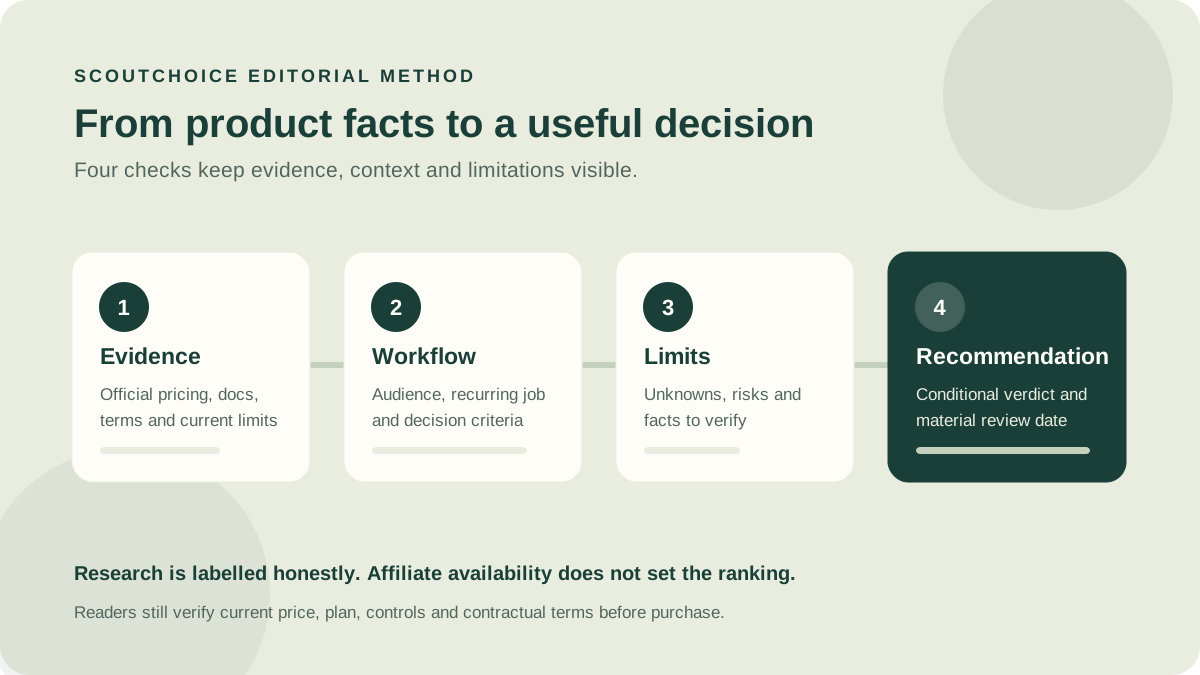
Before ranking products, ScoutChoice defines the audience, workflow stages and decision criteria. This contextual approach is central to how ScoutChoice reviews AI tools. A sales guide may distinguish CRM, enrichment, outreach and conversation intelligence; a project-management guide may distinguish scheduling, tasks, knowledge and automation. Products are evaluated against the relevant job instead of a universal feature checklist.
- Define the reader and recurring workflow.
- Identify the outcomes, constraints and major failure modes.
- Create a shortlist of products that genuinely address the job.
- Check current first-party product and commercial information.
- Compare strengths, limitations, implementation and total cost.
- Write a recommendation with explicit conditions and alternatives.
Head-to-head comparisons use the same principle. The verdict should explain who should choose each product and why. If two tools serve substantially different jobs, the comparison must state that difference rather than manufacture a single winner.
6. Commercial independence and affiliate links
Affiliate availability does not determine whether a tool is included, excluded or ranked first. Most ScoutChoice links are ordinary editorial links. When an active affiliate destination is used, it should be disclosed near the link and marked appropriately for search engines.
A commission may affect ScoutChoice revenue if a reader purchases after clicking, but it must not change the evaluation criteria or remove important limitations. Readers can always navigate independently to the provider, and inclusion in the directory is not a guarantee or endorsement.
7. Updates, dates and material changes
Updates are an essential part of how ScoutChoice reviews AI tools because AI software changes quickly. A review date describes when material information was last checked; it does not promise that every field remains unchanged afterward. Before paying, readers should confirm current price, plan name, usage allowance, region, integration, model access and contractual terms on the provider’s official site.
A page should be reviewed after a material product change, discontinuation, pricing change, correction, major model release or evidence that the recommendation no longer fits. Small stylistic edits should not be presented as a complete product re-review.
8. Corrections and reader feedback
Corrections can be reported through the ScoutChoice contact page. A useful report identifies the page, exact statement, why it appears wrong and a current supporting source. Product vendors may submit factual evidence, but ScoutChoice retains editorial control over descriptions, rankings and conclusions.
Material corrections should update the affected content and review date. A disagreement about an editorial preference is considered against the stated audience and methodology; it is not automatically treated as a factual error.
9. Site-wide quality and indexation rules
ScoutChoice includes dynamic reference tools for pricing, alternatives and side-by-side exploration. Those routes may help a visitor navigate even when they do not yet contain enough page-specific analysis to stand alone in search. They can therefore remain accessible while being excluded from indexing until editorial work adds distinct value.
Original guides, curated rankings, editorial comparisons and sufficiently complete product profiles are the primary searchable library. Pages should be linked from a relevant hub, provide a clear answer, disclose their method and avoid repeating another page with only a product name changed.
10. Reference standards behind the methodology
The process is informed by public standards rather than invented SEO tests. Google Search Central’s guidance on helpful, reliable, people-first content provides questions for assessing originality, completeness and reader value. The NIST AI Risk Management Framework provides a voluntary structure for considering AI risks, while the US Federal Trade Commission’s endorsement and review guidance informs clear disclosure of material commercial relationships.
These references guide transparency and evaluation discipline; they do not certify ScoutChoice, endorse a ranking or replace product-specific evidence. The practical explanation of how ScoutChoice reviews AI tools remains the methodology published on this page.
11. How readers should use ScoutChoice
Use ScoutChoice to define a shortlist and questions, not to outsource the final decision. Verify material facts, model complete cost, test representative work, review privacy and security, and keep a record of why the chosen product meets the actual requirement.
The 12-point evaluation framework, pricing calculator, privacy and security checklist and 30-day pilot provide a repeatable route from discovery to a controlled decision.
Editorial standards FAQ
Does ScoutChoice test every AI tool?
No. ScoutChoice distinguishes official-source research from representative hands-on testing and should not imply direct use where it did not occur.
Can a company pay for a higher ranking?
No. Affiliate or partnership availability must not determine editorial order or the inclusion of limitations.
Why can editorial shortlists recommend different tools?
Each shortlist applies criteria for one audience and workflow, so a specialist may be the better contextual choice. Its reasons and limitations should explain the order; numerical product ratings are not published.
How can I report outdated information?
Use the contact page and include the URL, exact statement and a current supporting source so the correction can be checked efficiently.
Limitations
ScoutChoice provides general software research and decision support. It does not provide legal, financial, medical, cybersecurity or procurement advice, guarantee vendor performance or replace review of current product documentation and contractual terms. The methodology will evolve when stronger evidence or a clearer evaluation method becomes available.