An AI tool RFP template helps a buying team compare proposals against the same workflow, evidence and scoring rules. The best RFP is not the longest document. It gives suppliers enough context to respond precisely, separates mandatory gates from weighted preferences and defines how claims will be verified.
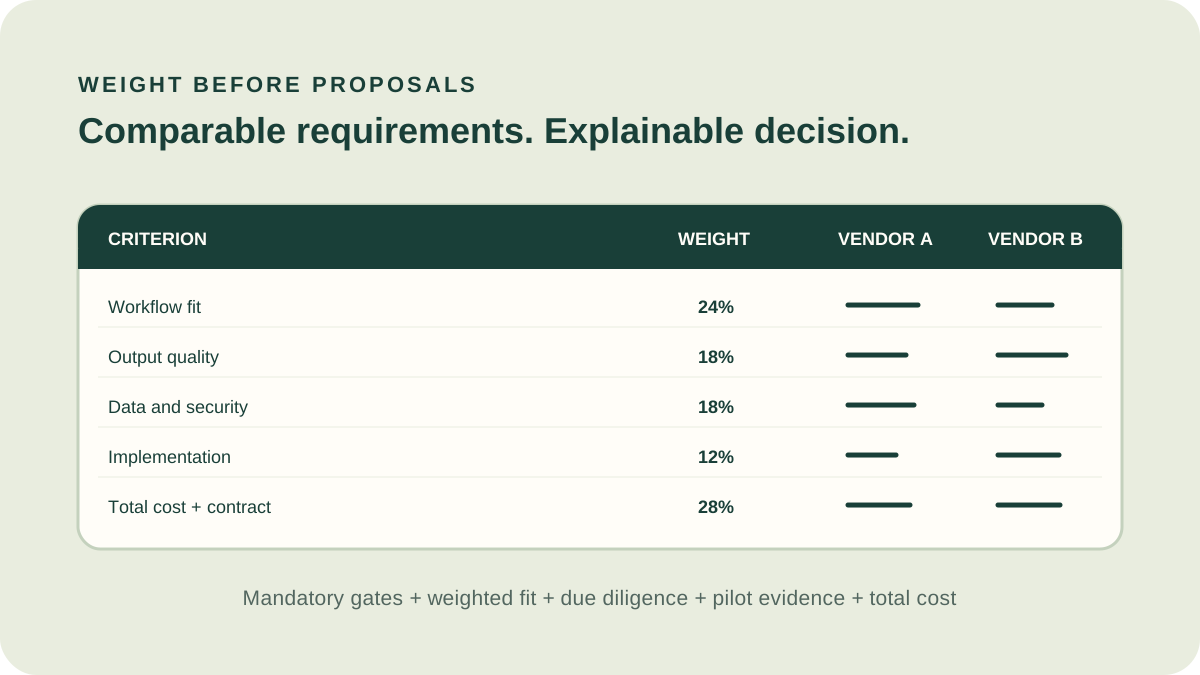
Use the matrix above after the team agrees the criteria and weights, not after a preferred vendor emerges. Score only evidence that addresses the exact plan and deployment. Preserve comments behind each number so a small difference does not create false certainty.
1. Purpose of an AI tool RFP template
An RFP creates a consistent evidence request and auditable comparison. It should help the organization select a suitable service and configuration, not reward the supplier that produces the most attractive generic response. The outcome may be a shortlist, negotiation, limited pilot or decision not to buy.
Use a lighter request for a low-cost, low-impact tool and a more formal process for sensitive data, broad deployment, autonomous action or difficult switching. Procurement effort should follow exposure and dependency rather than vendor prestige.
2. Give vendors a precise scenario
Describe current workflow, problem, baseline, users, volumes, languages, systems, data classes, output destination, human review and expected implementation. State what the AI may not do. Distinguish launch scope from possible future expansion so suppliers price and evidence the real requirement.
Provide representative use cases and edge cases without disclosing restricted data. Specify expected integrations and administrative needs. A vendor cannot answer accurately if “enterprise AI platform” is the entire requirement.
3. Structure requirements for comparable answers
Divide the document into instructions, organization and workflow context, mandatory gates, scored requirements, pricing schedule, evidence request, pilot, contract principles and response format. Ask vendors to mark standard capability, configuration, custom work, roadmap or unavailable.
| Requirement type | Use | Scoring |
|---|---|---|
| Mandatory gate | Essential condition with no routine trade-off | Pass, fail or authorized exception |
| Weighted criterion | Meaningful difference among viable proposals | Defined 1–5 evidence scale |
| Information | Context for implementation or negotiation | Not added to product score |
| Pilot measure | Claim requiring representative testing | Observed result against baseline |
Define a scoring rubric
A score of 1 may mean unsupported or materially below requirement; 3 can mean the requirement is met with acceptable evidence; 5 should mean verified performance that materially exceeds the need. Do not give bonus points for irrelevant features. If evaluators interpret the scale differently, the decimal result is decoration.
Weights must total 100 and reflect the use case. Sensitivity-test the decision by changing plausible weights. If a small adjustment reverses the winner, describe the result as close and resolve the underlying uncertainty.
4. Ask for evidence, assumptions and exceptions
Require a source and scope for material answers: product documentation, contract schedule, current assurance, tested export, service history or pilot result. Ask the vendor to identify exclusions, customer configuration, third-party dependencies, extra charges and roadmap items.
CISA’s Secure by Demand Guide helps customers ask software manufacturers about security outcomes, while NIST SP 800-161r1 addresses supply-chain risk management. Use these as authoritative inputs, then tailor the request to the AI workflow and risk record.
5. Run a fair evaluation process
Give all suppliers the same instructions, deadline and material clarifications. Use a question log and issue answers consistently. Screen mandatory gates before detailed scoring. Evaluators should score independently before a moderated discussion to reduce anchoring and authority bias.
Record conflicts of interest and do not let gifts, existing relationships or a compelling demonstration replace evidence. A demo follows the seller’s path; a pilot follows the buyer’s cases. Use the vendor due diligence checklist on shortlisted suppliers.
Evaluate total cost, not headline price
Request a consistent pricing schedule: subscriptions, minimum seats, usage units, overages, implementation, integrations, support, training, storage, environments, taxes, renewal assumptions and exit assistance. Model realistic growth and compare it with the AI software pricing guide.
Separate product score from total cost so a team can see the trade-off. Do not quietly convert the cheapest proposal into the highest value or allow features to obscure an unaffordable usage model.
6. Shortlist, pilot and document the decision
Apply mandatory gates, weighted score, due diligence, reference checks, total cost and contractual risk. Use the matrix to organize judgment, not automate it. Document reasons for exclusions and any adjustment to published scoring.
Test uncertain, important claims through the 30-day pilot method. Set baseline, cases, owners, stop rules and success thresholds before access begins. Update the decision with observed evidence rather than adding pilot impressions informally.
Never change weights after opening proposals without documenting and approving the reason. Post-hoc weighting turns a comparison framework into justification for a preferred answer.
7. RFP examples
Meeting intelligence
Test transcription on actual accents and conditions, summary accuracy, permissions, participant controls, CRM actions, retention and export. Price storage, seats and recording volume.
AI writing platform
Evaluate workflow fit, brand controls, factual verification, rights, collaboration, administration and model-improvement terms. Do not score generic output fluency alone.
Support automation
Measure resolution quality, incorrect action rate, escalation, language performance, audit trail and recovery. Require a safe limit on autonomy during the pilot.
Common AI RFP mistakes
- Copying requirements that do not match the workflow.
- Using hundreds of yes/no questions without evidence standards.
- Letting every desired feature become mandatory.
- Setting weights after seeing vendor responses.
- Scoring roadmap promises like current capability.
- Mixing product fit, cost and contract risk into one unexplained number.
- Skipping a pilot for the claims that matter most.
AI tool RFP template FAQ
This AI tool RFP template should remain traceable: requirements connect to evidence, scores connect to comments and the final choice connects to an authorized decision.
How many criteria should an RFP score?
Use the smallest set that distinguishes viable proposals. Group detailed questions under clear criteria and keep mandatory gates separate.
Should price receive a weight?
It can, but show total cost separately as well. The organization needs to understand affordability and product fit, not only a blended number.
Can one person score every proposal?
A low-impact purchase may be simple, but material selections benefit from relevant domain reviewers and moderated scoring with a named decision owner.
What happens after the RFP?
Shortlist, verify due diligence, pilot uncertain claims, negotiate contract protections and preserve a decision record with conditions and review triggers.
Methodology and limitations
ScoutChoice’s AI tool RFP template uses six weighted areas: workflow fit, quality, data and security, implementation, service and total cost. The example weights total 100 and can be changed locally. Vendor names and scores are not transmitted or stored.
This guide is general procurement information. Adapt requirements, process and scoring to organizational authority, public procurement rules, competition requirements, applicable law and the actual use case.