An AI contract checklist helps a buying team confirm that negotiated documents match the approved product, plan, workflow, data, risk, price and exit. It is a coordination tool for business, procurement and specialist review—not a substitute for legal advice or a universal set of clauses.
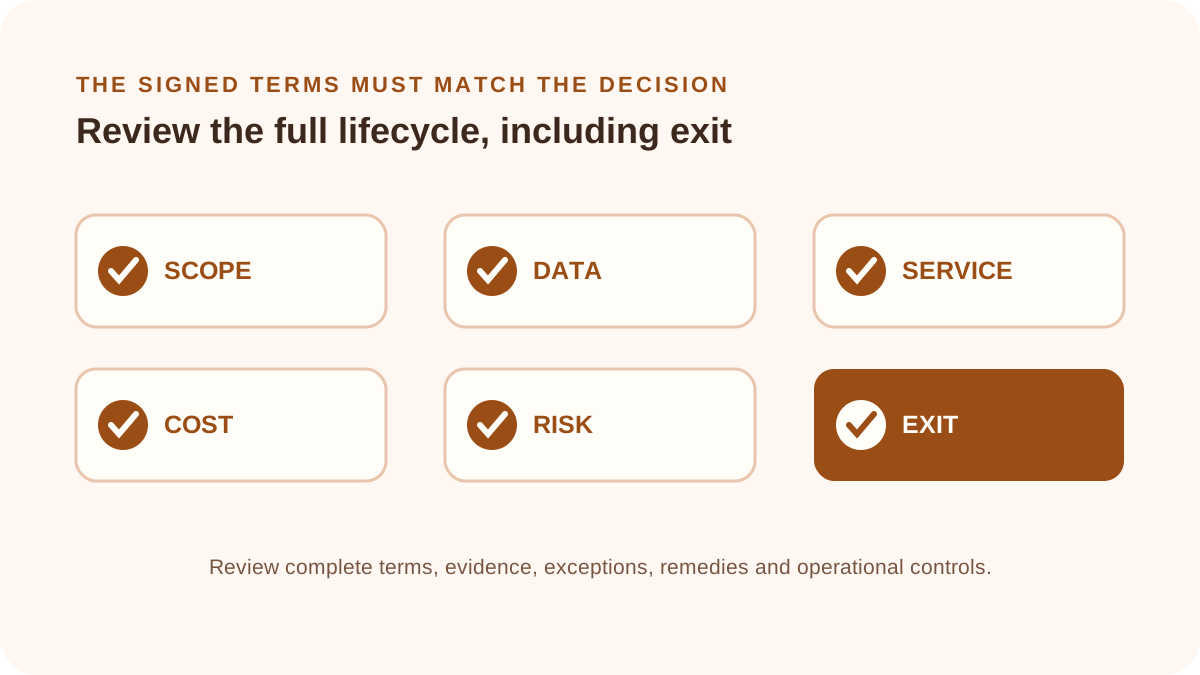
Use the tracker above to record whether each topic has been reviewed in the complete agreement. Check the order form, master terms, data terms, service schedule, security exhibit, acceptable-use rules and incorporated web documents together. A favorable sentence in one document may be limited by another.
1. Purpose of an AI contract checklist
The review should make responsibilities, evidence, remedies and change control sufficiently clear for the actual use. It should prevent a gap between what sales demonstrated, what the pilot tested, what governance approved and what the supplier is contractually committed to provide.
Risk and negotiating leverage vary. A standard online subscription for a low-impact task may warrant a limited deployment or alternative supplier when terms cannot change. A high-dependency service may justify detailed schedules, transition support and stronger remedies.
2. Identify the complete agreement and service
List every incorporated document with version or date and establish precedence. Identify legal entities, service, plan, users, environments, regions, AI features, model providers and permitted use. Capture customer configuration and cooperation responsibilities.
Check whether the supplier can update online terms unilaterally and what notice, objection, termination or grandfathering rights apply. A contract should not promise a fixed control while an incorporated policy allows it to disappear without meaningful response.
3. Align scope with the approved workflow
Translate the due diligence record and risk assessment into commitments and customer actions. Define prohibited data and uses, permissions, human oversight, monitoring and administrative settings.
| Topic | Question | Operational evidence |
|---|---|---|
| Service | What exact plan and features are supplied? | Order form and service description |
| Data | What may the provider do with inputs and outputs? | Data terms and product configuration |
| Change | What happens after a material model or provider change? | Notice, test and response rights |
| Exit | Can the customer retrieve and delete information? | Tested export and deletion schedule |
4. Review data, security and AI use
Establish roles, instructions, permitted purposes, confidentiality, subprocessors, locations, transfers, security measures, assistance, retention, return and deletion. Address prompts, uploads, outputs, logs, metadata, feedback and support data rather than using “customer data” without definition.
Clarify whether any content is used to train, fine-tune, evaluate or improve models and whether settings or service tiers change the answer. The UK ICO’s contracts and third parties AI audit framework highlights defining roles, responsibilities and information flows. Determine applicable obligations with qualified counsel.
Make incident and audit terms usable
Define which incidents trigger notice, to whom, by what channel, within what period and with which updates and cooperation. Align supplier notice with the customer’s own investigation and reporting deadlines. Avoid a notice promise that starts only after the provider completes an undefined confirmation process.
Audit and assurance rights should be proportional and practical. Current independent reports may satisfy routine review, while serious incidents, material changes or credible control concerns may require further information or cooperation.
5. Define service, changes and remedies
Address availability measurement, exclusions, support severity, response, recovery, maintenance, capacity and continuity. Credits alone may not protect a workflow where repeated failure causes greater loss. Include escalation and termination rights appropriate to material or persistent breach.
AI services change frequently. Define material change, notice and the customer’s ability to assess a new model, subprocessor, location, feature, limitation or pricing unit before it affects the approved workflow. Preserve a controlled fallback where continuity matters.
Verify the complete price mechanism
Document subscriptions, minimum seats, credits, tokens, storage, overages, implementation, integrations, premium support, taxes, renewal, indexation and exit assistance. State measurement, reporting and dispute processes for variable usage. Model the figures with the hidden-cost calculator.
Record cancellation windows and automatic renewal. A negotiated first-year discount is not the long-term price. Consider what happens when usage grows, a feature moves tier or the provider changes the unit used for billing.
6. Address liability, IP and exit
Review ownership and permitted use of inputs, outputs, feedback, configurations and custom work. Consider third-party claims, customer instructions, provider warranties, disclaimers, indemnity process, liability caps, exclusions and insurance in the context of plausible harm. Do not infer that “you own your output” guarantees originality, accuracy or non-infringement.
An exit plan needs usable exports, formats, timing, assistance, cost, continued access, deletion and verification. Test export during the pilot when dependency would be material. Define termination rights for service, security, provider or legal changes that the organization cannot accept.
A checked clause is not necessarily an acceptable clause. The tracker records review completion. Preserve the position, evidence, owner, exception and approval separately.
7. Contract review examples
Online self-service terms
When terms are non-negotiable, reduce exposure, choose a suitable plan, prohibit sensitive workflows or select another provider. Acceptance is still a risk decision.
Enterprise assistant
Attach service, security, data and pricing schedules that identify enabled features and regions. Ensure sales commitments survive in the signed order and document precedence.
AI agent with system access
Address permission limits, authorized actions, logs, human approval, suspension, incident support and rollback. Contract language cannot replace technical enforcement and monitoring.
Common AI contract mistakes
- Reviewing the master agreement but not incorporated online terms.
- Using broad “customer data” language that misses prompts, outputs or logs.
- Assuming vendor documentation creates a contractual commitment.
- Ignoring model, subprocessor and feature change rights.
- Checking an SLA without validating measurement and exclusions.
- Comparing first-year price instead of complete renewal and usage cost.
- Waiting until termination to test export and deletion.
AI contract checklist FAQ
Use the AI contract checklist alongside the approved risk, due diligence, pricing and implementation records so negotiated terms remain connected to operational reality.
Is a separate AI addendum always required?
No. Required protections can appear across existing documents, but the complete agreement must address the actual AI use and dependencies coherently.
What if the provider will not negotiate?
Decide whether standard terms fit the use. Limit data, users, autonomy or dependency, accept through proper authority, or choose another service.
Should outputs be owned by the customer?
Review rights needed for the workflow, but ownership wording does not establish output accuracy, originality or freedom from third-party rights.
When should the contract be reviewed again?
At renewal and after material changes to service, use, data, providers, pricing, terms, law or observed incidents.
Methodology and limitations
ScoutChoice’s AI contract checklist groups 18 review areas under scope, data, service, cost, risk and exit. Critical gaps remain visible regardless of overall completion. Browser storage retains checklist state on the current device until reset.
This content is general procurement information and not legal advice. Contract language and enforceability depend on the parties, jurisdiction, sector, bargaining position and facts. Obtain appropriate legal, security, privacy, tax and commercial review.