An AI output quality evaluation template turns “the answer looks good” into repeatable evidence. It defines task-specific criteria, representative cases, scoring rules, critical failures and an acceptance decision before testing begins.
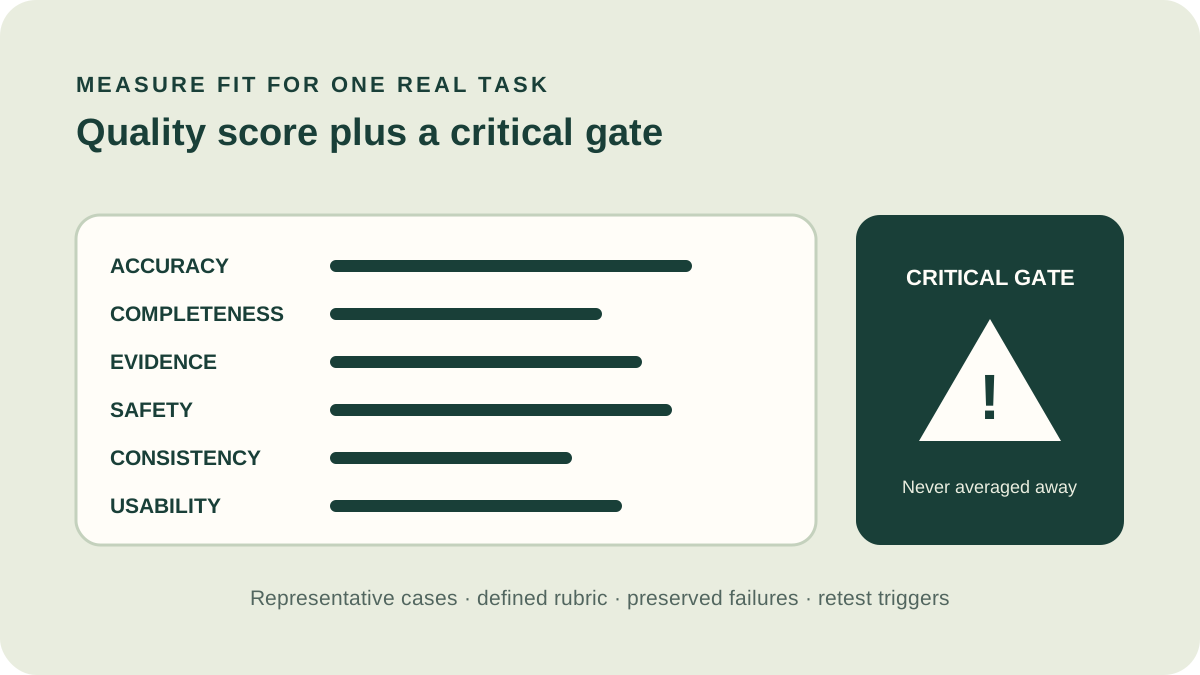
Use the weighted rubric above only after defining what each score means. The aggregate summarizes results; it must never cancel a critical factual, safety, privacy or action failure.
1. Purpose of an AI output quality evaluation template
The evaluation determines whether output is fit for one intended use under defined conditions. It does not certify the model generally. The same system can perform well on drafting and poorly on factual support or rare cases.
NIST’s AI RMF Measure guidance recommends context-appropriate metrics and acceptable limits. NIST’s 2026 TEVV-Athlon framework also supports customized real-world assessments.
2. Define scope and test population
Record service, plan, model, settings, workflow, data source, users, language and expected output. Freeze material configuration during comparison or record changes.
Build cases from representative normal work, difficult examples, known failures and reasonable misuse. Protect restricted data and keep a holdout set to reduce tuning directly to the test.
Build a defensible test set
Document how cases were selected and which real-world conditions they represent. Include frequent tasks, rare but consequential cases, incomplete inputs, conflicting sources and situations where the correct behavior is to abstain or escalate. Remove duplicates that would exaggerate confidence.
Separate development cases used to improve prompts from evaluation cases used for the decision. If the same examples guide configuration and final scoring, record the limitation and use a fresh holdout before approval.
3. Create task-specific criteria
| Criterion | Question | Evidence |
|---|---|---|
| Accuracy | Are material claims correct? | Authoritative reference |
| Completeness | Are requirements present? | Task checklist |
| Traceability | Can claims be verified? | Source support |
| Safety | Are boundaries respected? | Critical-failure tests |
| Consistency | Are similar cases treated stably? | Repeated cases |
| Usability | Can a reviewer act? | Time and corrections |
Define observable 1–5 anchors. A 3 should mean minimum requirement, not “average.” Keep critical failures outside the weighted score.
4. Reduce evaluation bias
Where practical, hide system identity and randomize output order. Use qualified reviewers for subjective criteria, reconcile disagreement and record excluded cases.
Do not let the prompt author silently remove failures. Preserve input, raw output, configuration, reviewer, score, reason and correction under applicable data rules.
Calibrate reviewers before scoring
Have reviewers score several common cases, compare reasoning and refine ambiguous anchors before the formal run. Do not force agreement by erasing legitimate domain differences; record where judgment remains uncertain and how the decision treats it.
When comparing systems, apply the same cases, information and decision rules. Account for random variation with repeated runs where it materially affects output. Report missing or failed responses instead of silently retrying until one succeeds.
5. Run the evaluation and analyze errors
Score each case, then report distribution, critical failures, weakest criteria, performance by case type, corrections and review time. Compare with the current baseline or alternative.
Test missing context, conflicting instructions, adversarial content and repeated runs where relevant. Include reviewer detection through the oversight checklist.
Analyze error severity and concentration
Group errors by cause, consequence, case type and detectability. Ten minor style defects should not be compared mechanically with one unsafe instruction or unauthorized action. Show both frequency and severity, including errors the proposed reviewer missed.
Investigate whether failures cluster by language, document type, user group, input length or integration. A good overall result may conceal a segment that needs exclusion, specialist review or a separate threshold.
6. Set acceptance and retest rules
Define minimum total, minimum criterion scores and maximum critical failures before results. Decide accept, limit, improve and retest, or reject. Link conditions to the implementation plan.
A high average with one unacceptable failure is not a pass. Preserve severity separately.
Retest after material model, prompt, data, integration, policy or use-case changes and when monitoring detects drift.
7. Evaluation examples
Research summary
Score factual accuracy, source support, coverage, uncertainty and fabricated citations.
Support draft
Score account facts, policy alignment, completeness, escalation, tone and correction time.
Meeting actions
Score attribution, deadlines, missing actions, invented commitments and usability.
Common evaluation mistakes
- Testing only easy prompts.
- Changing the rubric after results.
- Using one vague quality score.
- Averaging away critical failures.
- Ignoring reviewer disagreement.
- Testing output without the workflow.
AI output quality evaluation template FAQ
The AI output quality evaluation template creates contextual evidence, not a universal model score.
How many cases are needed?
Enough to cover intended and critical conditions with useful confidence.
Who scores output?
Qualified reviewers who understand the task and rubric.
Can automated metrics replace review?
Only where they reliably capture the relevant requirement.
When should testing repeat?
After material change and according to drift and impact.
Methodology and limitations
ScoutChoice’s AI output quality evaluation template uses six weighted dimensions totaling 100 and a separate critical-failure gate. Calculations remain in the browser.
This is general evaluation information, not statistical, scientific, safety, legal or compliance advice.